

How a first-year SID tackles 20 teams and saves 30 hours per month doing it
April 28, 2026
There’s a version of a sports information director’s first year on the job that looks manageable on paper.
You know the scope going in: recaps after every game, social media every day, graphics for game days and award announcements, stats, live streams, website updates, and staffing home events. You know no two weeks look the same. You know the calendar keeps moving whether you’re ready or not.
Haley Jung knew all of that when she stepped in as Director of Sports Information Programs at Hamline University. What she didn’t fully know yet was how to carry it all — until she found her footing with a tool she wasn’t sure she needed.
Who: Hamline University
Nickname: Pipers
Division: NCAA Division 3
Conference: Minnesota Intercollegiate Athletic Conference (MIAC)
Varsity Sports: 20 sports
Location: St. Paul, Minnesota
FanWord Partner Since: August 2025
Fun Fact: Hamline played in the first-ever intercollegiate basketball game on February 9, 1895, losing 9-3 to the Minnesota School of Agriculture.
Challenge: Every week is a different week
The scope of the job at Hamline is broad by any measure.
Jung’s week starts Monday, one of the busiest of the seven. Staff meetings, a weekly athletics schedule graphic, Pipers of the Week nominations, conference athlete of the week submissions, national rankings posts, and a full inbox of emails to work through.
Game week starts on Monday or Tuesday, is in full swing by Wednesday night, and the pattern doesn’t really let up until the final boxscore goes up on Sunday evening.
“A typical week looks like: game day graphics, writing recaps, working home events, updating social media, and whatever else might pop up,” Jung said. “No one week is the same and no one day schedule is the same.”
For a first-year SID covering 20 sports, Jung described weeks where she worked well over 40 hours, staying up until late at night to finish recaps after multi-sport game days, fielding texts and emails from coaches long after leaving campus.
The hardest part, she said, is managing the volume across all programs at once — and finding enough hours to do each one justice.
Solution: A tool she didn’t know she needed
Jung inherited FanWord Assist when she arrived at Hamline, passed down from the previous SID. Her initial reaction was cautious.
“I was a little nervous jumping back into the story writing aspect and stats pieces of the position since it had been a little while since doing both,” she said. “Being given FanWord as a tool the moment I started on campus was something that I was also wary of at first, as someone who had not been super big on the AI bandwagon as it began to grow.”
A quick tutorial from the FanWord team changed that. Dropped into the middle of fall season and already treading water, she started using it — and the value became clear fast.
The workflow clicked immediately. After a home game, Jung heads home, loads the boxscore into FanWord while she’s sorting through photos, and by the time the recap generates she’s ready to read through, make her edits, and post. What used to mean staying up until late after a three- or four-event night became something she could actually finish at a reasonable hour.
“It saves me a lot of time and stress where I would normally be up until ungodly hours of the night after getting home from games to finish recaps,” she said. “It helps simplify the process and takes a lot of weight off my shoulders as an SID to know that my information is going to be accurate and that I can get it out at a reasonable time once the game concludes.”
The consistency benefit has been just as meaningful. With 20 sports to cover, maintaining a professional, uniform voice across every program is a challenge in itself. FanWord handles the structural foundation so Jung can focus on the story angle rather than starting from a blank page or a basic template every time.
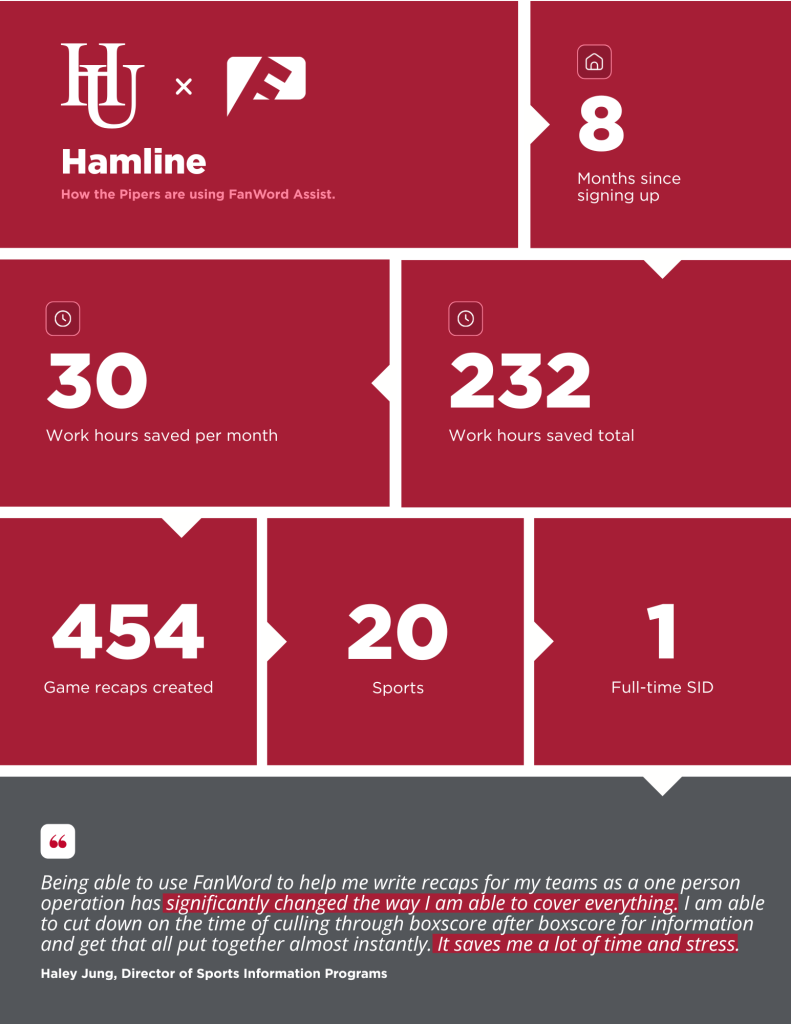
Since becoming a FanWord partner, Hamline has generated 454 game recaps across 20 sports in over 200 days of active use.
Bonus: Earning trust in a new role
At FanWord, we talk at length about the time-saving impact that comes with our platform, but there’s another angle worth noting for Jung.
FanWord Assist as a tool that builds confidence in a new position.
Walking into a full-time SID role with a packed sport schedule already in motion is a high-pressure starting point. Having a tool that handled the structural lift of recap writing meant Jung could focus her energy on learning the job, building relationships with coaches, and developing the editorial instincts that make a communications program feel distinct.
“I believe it has been a game changer for me and has helped me have a more successful first year as an SID,” she said.
That’s a different kind of impact than hours saved, and it speaks to what FanWord is actually built to do: give communicators more room to do the work they love most.
Result: 30 hours saved per month
Hamline has saved over 230 hours of work-time since becoming a partner.
On average, that’s more than 30 hours saved per month or the equivalent of a part-time worker’s hours each week. For Jung, that time goes directly back into the work that drives visibility and connection.
“FanWord has helped take off so much extra workload of writing recaps so that I can use my time more wisely and efficiently for things that make a bigger impact for our athletes,” she said.
For a first-year SID navigating 20 sports on her own, the downstream effect is consistent, professional coverage across every program and a more sustainable pace through crossover season and the longest stretches of the year.
Her message to any SID who’s skeptical about adding a new tool to an already full plate?
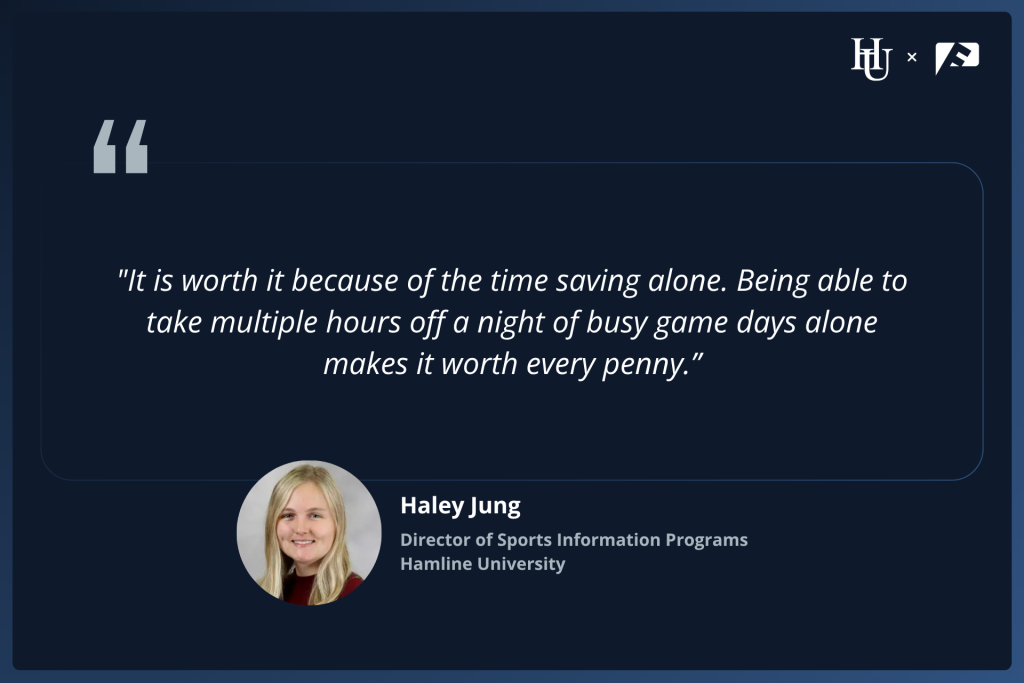
“It is worth it because of the time saving alone. Being able to take multiple hours off a night of busy game days alone makes it worth every penny.”
FanWord is built for the communicators doing the work
At small college programs across the NCAA, NAIA, and NJCAA, college sports communicators are covering full slates of sports with lean resources and authentic passion for the athletes they service.
FanWord Assist is built to give them time back.
Across more than 200 programs, FanWord Assist is helping save thousands of hours every season as the infrastructure behind college athletics communications:
- Streamlining hundreds of game recaps for communicators like Haley
- Creating player bios for athletes’ roster pages
- Simplifying the process of selecting and submitting award nominations
- Generating in-depth, human-interest feature stories
- Transcribing audio and video files
- Scaling the process of coordinating and conducting interviews
FanWord Assist is the go-to solution for athletic communication teams in college sports. While the application may look different at every school, the outcome is the same for every user: more time for the work that matters most to them.
See what FanWord can do for your communications team:
➡️ Request a demo using the contact form below
➡️ Reach out to our CEO directly to talk through your team’s workflow
➡️ Read more case studies: Florida Southern — Tulsa — Illinois Tech — KCKCC — Stetson — Northwestern College
